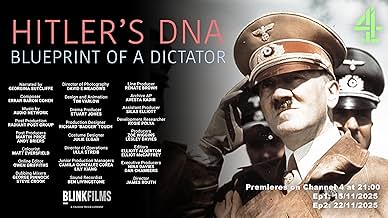
Michael was recently part of the Channel 4 documentary, Hitlers DNA – Blueprint of a Dictator
Here is a Link



The results of this study show that for Irish primary school children, the probability of psychiatric illness is positively associated with low IQ and reading difficulties, large family size, being a boy rather than a girl, and having a mother who is dissatisfied with her marriage or her role as mother.
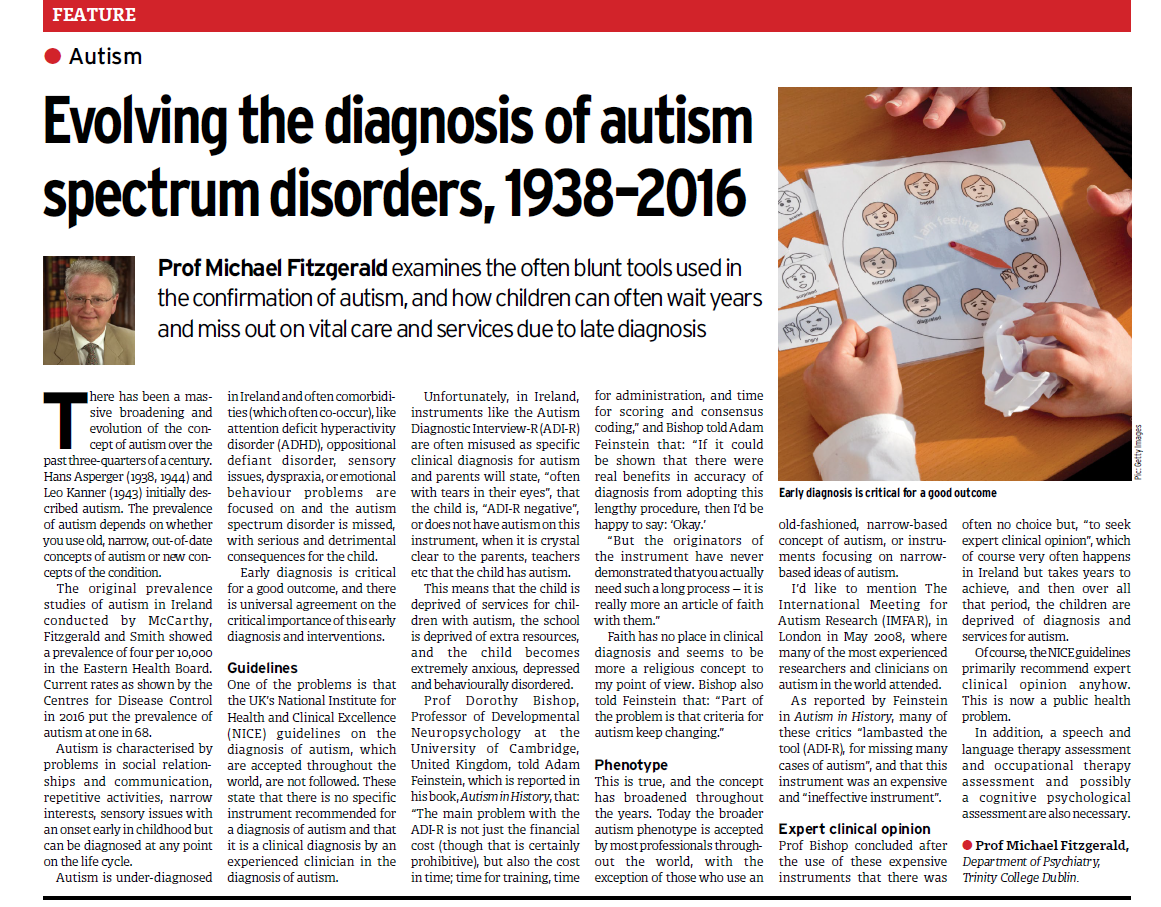 There has been a massive broadening and evolution of the concept of autism over the past three-quarters of a century. Hans Asperger (1938, 1944) and Leo Kanner (1943) initially described autism. The prevalence of autism depends on whether you use old, narrow, out-of-date concepts of autism or new concepts of the condition. The original prevalence studies of autism in Ireland conducted by McCarthy, Fitzgerald and Smith showed a prevalence of four per 10,000 in the Eastern Health Board. Current rates as shown by the Centres for Disease Control in 2016 put the prevalence of autism at one in 68. Autism is characterised by problems in social relationships and communication, repetitive activities, narrow interests, sensory issues with an onset early in childhood but can be diagnosed at any point on the life cycle. Autism is under-diagnosed in Ireland and often comorbidities (which often co-occur), like attention deficit hyperactivity disorder (ADHD), oppositional defiant disorder, sensory issues, dyspraxia, or emotional behaviour problems are focused on and the autism spectrum disorder is missed, with serious and detrimental consequences for the child. Early diagnosis is critical for a good outcome, and there is universal agreement on the critical importance of this early diagnosis and interventions.
|
Ada Byron
Daughter of Lord Byron
Countess of Lovelace
|

Great female mathematicians are less common than males and are described in this book, the Mind of the Mathematician written by internationally famous mathematician Prof. Ioan James and accomplished psychiatrist Prof. Michael Fitzgerald look at the complex world of mathematics and the mind. This book discussed the brilliant female mathematician Ada Byron and her major work with Charles Babbage and his calculating machines and associated disorder that she may have suffered from. What makes mathematicians tick? How do their minds process formulas and concepts that, for most of the rest of the world’s population, remain mysterious and beyond comprehension? Is there a connection between mathematical creativity and mental illness? In The Mind of the Mathematician, together they explore the behavior and personality traits that tend to fit the profile of a mathematician. They discuss mathematics and the arts, savants, gender and mathematical ability, and the impact of autism, personality disorders, and mood disorders. These topics, together with a succinct analysis of some of the great mathematical personalities of the past three centuries, combine to form an eclectic and fascinating blend of story and scientific inquiry. What makes the mathematician tick? How do their minds process formulas and concepts that, for most of the rest of the world’s population, remain mysteriously beyond comprehension? Is there a connection between mathematical creativity and madness?
In the Mind of the Mathematician, internationally famous mathematician Ioan James and accomplished psychiatrist Michael Fitzgerald look at the complex world of mathematics and the mind. Together they explore the behaviour and personality traits that tend to fit the profile of a mathematician. They discuss mathematics and the arts, savants, gender and mathematical ability, autism and mathematicians, and the impact of personality disorders and mood disorders. Mathematicians discussed include Gödel, Dirac, Hardy, Hadamard, Kovalevskaya, Poincare, and Gauss.
These topics, together with a succinct analysis of the great mathematical personalities of the past three centuries, combine to form an eclectic blend of story and scientific inquiry that will fascinate all those curious about how a mathematician’s mind really works.
|
|
Is Psychotherapy more than friendship?
|
|
|
Genesis of Artistic Creativity & the Yeats Family at the National Gallery, February, 2016
|
|
 Japanese Edition
Co-Author: Fitzgerald M. (2009)
– Considerable confusion surrounds the overlapping of autism and schizophrenia. This has significant implications for clinicians given that correct diagnosis is critical for treatment.
Design/methodology/approach
-This paper sets out to clarify the position by reviewing the history and current status of the relationship between autism and schizophrenia. A general review was conducted using a chronological approach that focused on phenomenology, aetiology, genetic mechanisms and treatment.
Findings
– Persons with autism are far more rigid, have difficulties set shifting and get far more upset and aggressive when their routines have changed. They have far more severe theory of mind and empathy deficits than those with schizophrenia.
Research limitations/implications
– Future diagnostic refinement by means of molecular genetic studies will alter the diagnostic categories. Further studies of the conditions of autism and schizophrenia are therefore necessary.
Practical implications
– Both conditions need treatment both clinically and practically.
Originality/value
– This paper elucidates the relationship between autism and schizophrenia from a historical and current perspective. It emerges that this confusion is likely to be resolved by molecular genetic studies that will alter the diagnostic categories.
   |
 |
 |
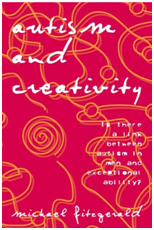
Autism and Creativity will prove fascinating reading not only for professionals and students in the field of autism and Asperger’s syndrome, but for anyone wanting to know how individuals presenting autistic features have on many occasions changed the way we understand society. This is quite simply the best book I have read on autism in history . . .
“Fitzgerald is clearly an experienced clinician and his deep understanding of the spectrum of autism conditions comes across in his writings. But he is also an exceptional scholar, and the thoroughness of his biographical research combined with his clinical acumen minimises the obvious risks inherent in historical diagnosis. He makes a plausible case for the Autistic mind being a different – and potentially highly creative – kind of mind“.
Professor Simon Baron-Cohen, Director, Autism Research Centre, Cambridge University.